
Published September 7, 2026
All-Cash Offers: How Buyers Without Cash Can Still Compete


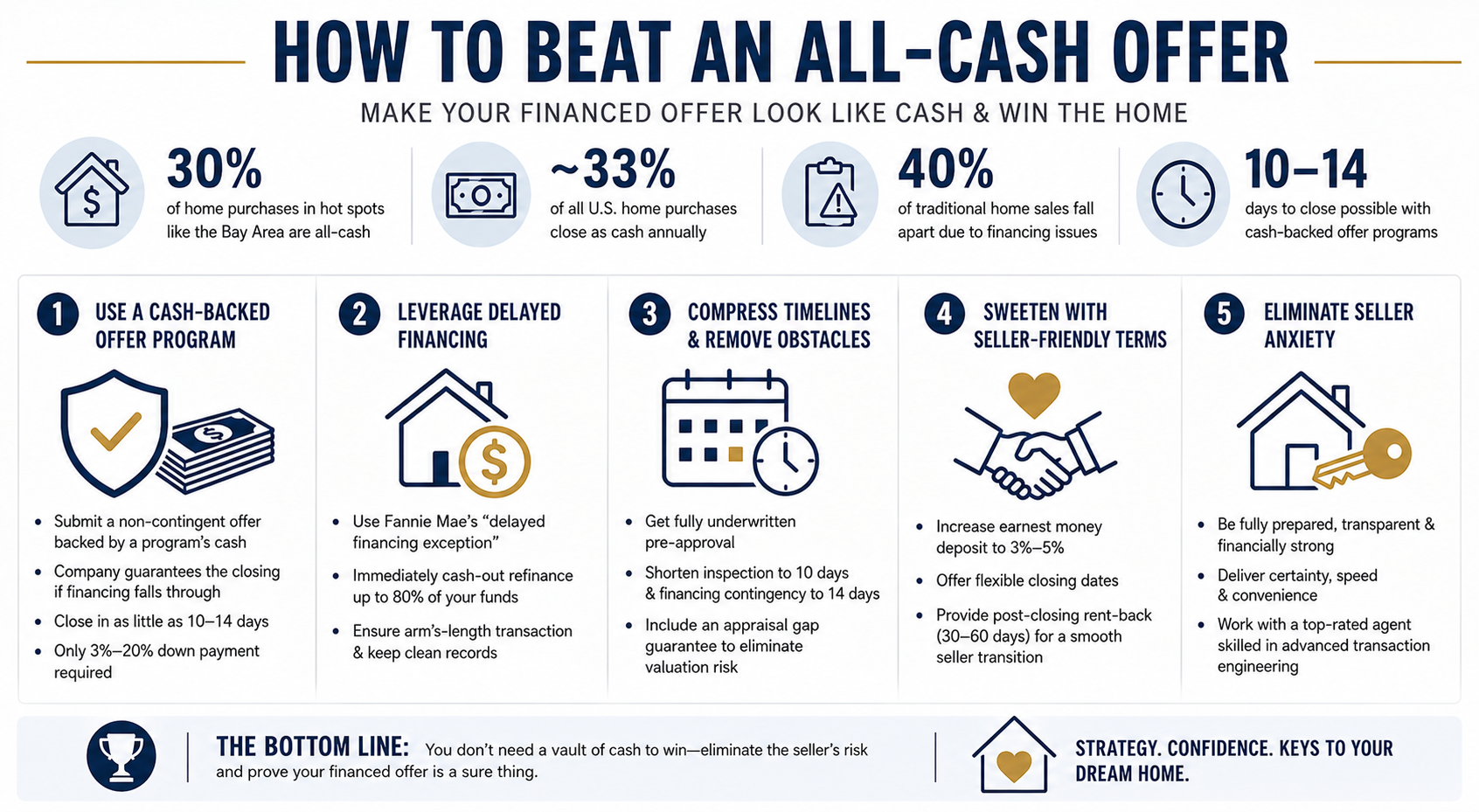
If you have ever tried to buy a home in a hot market, you already know the feeling: you find the perfect property, draft an offer, and then get hit with the news that you are competing against a wave of all-cash offers. It feels like bringing a plastic butter knife to a high-stakes sword fight. The data shows this is not just your imagination—roughly 30% of home purchases in hot spots like the San Francisco Bay Area are made in all-cash, and nearly a third of all U.S. home purchases close as cash transactions annually. For financed buyers, this can trigger a frantic search for the best real estate agent near me just to get an offer considered. Sellers prefer cash because they prioritize three primary things: speed, certainty, and convenience. To make matters worse, around 40% of traditional home sales fall apart before the finish line specifically because of mortgage and financing hiccups. But do not lose hope! You do not need a Scrooge McDuck vault of gold to win; you just need to know how to make your financed bid act like a cash deal.
The most popular shortcut to the front of the line is using a cash-backed offer program, often called a "power buyer" solution. Programs from companies like Flyhomes and Homeward act like an institutional wealthy uncle backing your play. After verifying your credit and assets upfront, these programs let you submit a bulletproof, non-contingent bid backed by their cash funds. If standard mortgage approval hits a last-minute snag, the company steps in to buy the home in cash on the scheduled closing date so the seller has absolute certainty. This allows you to close in as little as 10 to 14 days, and once the dust settles, you simply buy back the home from the program using a traditional mortgage. It gives you the ultimate competitive edge of cash while only requiring a standard down payment of 3% to 20% upfront.
If you have short-term liquidity available—like a home equity line of credit (HELOC) on another property, stock portfolios, or retirement accounts—you can pull off a brilliant hybrid maneuver known as delayed financing. Normally, if you buy a home in cash, banks force you to sit on your hands for a six-month holding period before you can do a cash-out refinance to recoup your cash. But under Fannie Mae’s "delayed financing exception", you can purchase the home outright in cash to bypass standard lender underwriting, appraisals, and financing contingencies. Once you are on the title, you can immediately apply for a cash-out refinance to pull up to 80% of your liquid capital back out of the property. Just make sure the purchase is a strict "arm's-length transaction" (no buying from your cousin or business partner) and that you keep spotless records of where your initial cash originated.
Even if specialized programs are off the table, you can still play defense by compressing your contract timelines to look like a high-speed cash deal. While typical California residential contracts default to a 17-day home inspection and 21-day finance contingency, you can work with a proactive lender to obtain a fully underwritten pre-approval before you even start looking at listings. This lets you safely compress those timelines to 10 days for inspection and 14 days for financing, proving to the seller that your deal has real momentum. To eliminate the seller's biggest fear—that the bank's appraiser will value the home below the contract price—you can include an appraisal gap guarantee. By pledging a specific cash reserve to cover any valuation shortfall out of pocket, you remove the appraisal roadblock that routinely derails financed transactions.
Sometimes, the little details are what tip the scales, and you can sweeten your offer with seller-friendly terms that cost you almost nothing. For starters, consider beefing up your earnest money deposit (EMD). While the traditional California standard is 1% to 3% of the purchase price, bumping it to 3% to 5% signals major financial confidence and serious intent. Beyond cash, focus on convenience. Selling a home is stressful, and sellers are often terrified of having to move twice. Offering a flexible closing date or a post-closing seller rent-back agreement—allowing them to stay in the home for 30 to 60 days after closing—can save them thousands of dollars in temporary housing and double-move headaches. When carrying costs and convenience are factored in, these personal touches can make your financed offer look far more appealing than a cold, rigid cash bid.
At the end of the day, beating an all-cash offer is not about spending money you do not have; it is about eliminating the seller’s anxiety. By showing up fully underwritten, with compressed contingency periods, and utilizing cash-backed offer strategies, you can confidently prove that your financed bid is a "sure thing." Partnering with a top-rated real estate agent who understands advanced transaction engineering is your ultimate secret weapon to navigating this wild market and landing the keys to your dream home with confidence.